
How to Start a Profitable Custom Sticker Business from Home (Without Printing Equipment)

The custom sticker and decal market is exploding. From small businesses needing branded labels to Etsy sellers creating aesthetic laptop decals, the demand is massive and growing. The best part? You don’t need a $50,000 printing press or even a home office to get started.
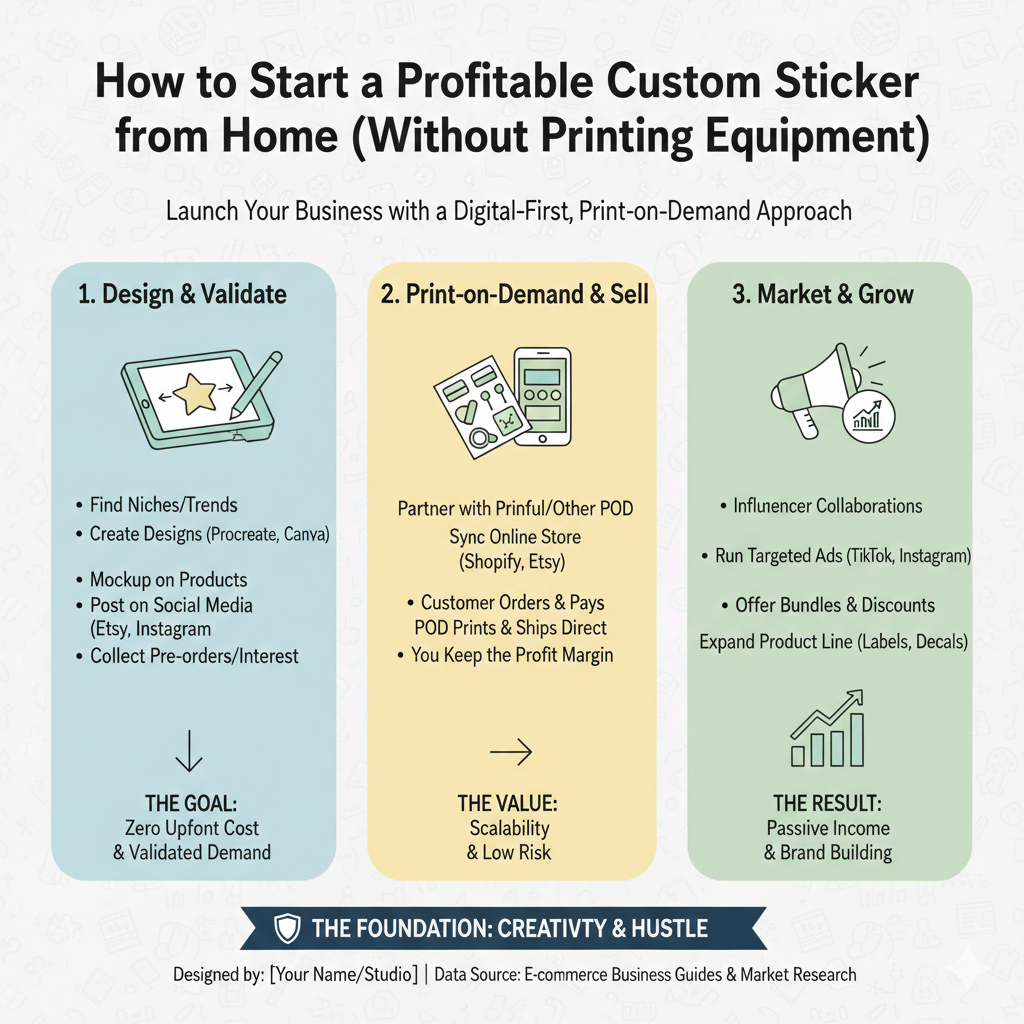
I’ve watched dozens of people build five-figure monthly businesses selling custom stickers without owning a single piece of printing equipment. Some started while working full-time jobs. Others turned it into their primary income within six months. Here’s exactly how they did it — and how you can replicate their success.
The Print-on-Demand Business Model That Works
Traditional sticker businesses require massive upfront capital. You buy printing equipment, stock vinyl and paper, learn color matching, master die-cutting, and pray you chose profitable niches. Most beginners fail before they sell their first hundred stickers.
Smart entrepreneurs are using a different approach: partnering with established printing companies as resellers or using print-on-demand platforms. You handle marketing, customer relationships, and design coordination. They handle production and often shipping too.
Here’s the beautiful part: Your margins stay healthy even without equipment. A custom business sticker sheet that costs you $3-4 from your supplier sells for $8-12 retail. Custom laptop decals with your supplier cost of $2 each sell for $6-10. At just 100 orders monthly, you’re making $500-800 profit with zero equipment investment or inventory risk.
Finding Your Profitable Niche (Not What You Think)
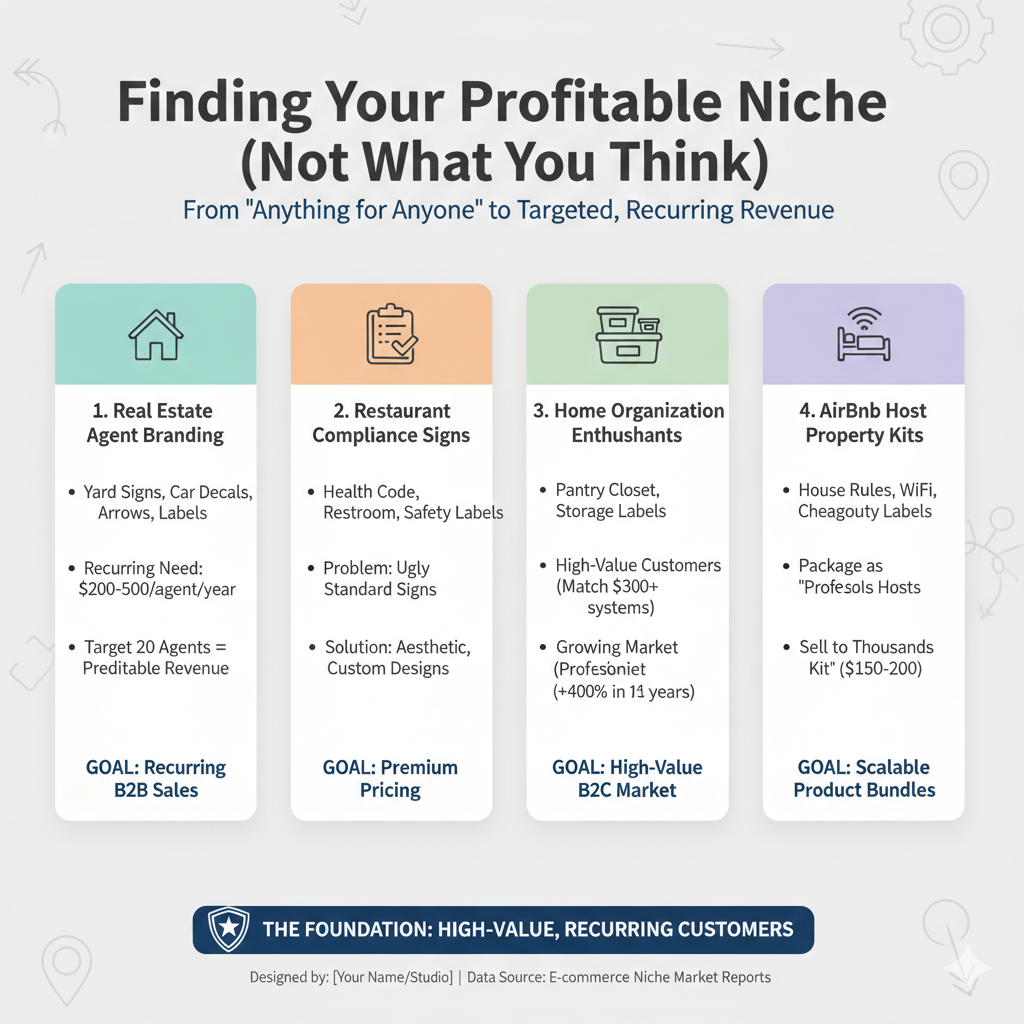
Most beginners make a fatal mistake: they try to sell everything to everyone. “Custom stickers for any purpose!” sounds good but converts poorly. Successful sticker businesses dominate specific niches.
Here are the niches quietly making people serious money:
Real Estate Agent Branding: Realtors need yard signs, car decals, open house directional arrows, and branded labels constantly. They spend $200-500 per year per agent. Target just 20 active agents and you have predictable recurring revenue.
Small Restaurant Compliance Signage: Every restaurant legally needs health code signs, bathroom instructions, and safety labels. The catch? They hate how ugly standard compliance signs look. Offer aesthetically designed versions that match their interior design and they’ll pay premium prices.
Home Organization Enthusiasts: People spending $300 on matching pantry containers will absolutely spend $40 on professional custom labels. This market grew 400% in the last three years and shows no signs of slowing.
Airbnb Host Property Kits: Vacation rental hosts need house rules signs, WiFi password displays, checkout instruction decals, and emergency contact labels. Package this as a “Professional Airbnb Signage Kit” for $150-200 and sell to thousands of hosts desperate to look more professional.
The pattern? Find customers who need stickers regularly (not once), have budget, and value professionalism over price. One-time buyers build a job. Repeat customers build a business.
Setting Up Your Brand Identity (This Part Matters More Than You Think)
Your business name will make or break your success. I’ve seen great operations struggle because their name was forgettable or already crowded with competitors.
Before you print business cards or create a website, test your name thoroughly. One entrepreneur I advised almost launched “Custom Label Co” before discovering there were 34+ businesses using nearly identical names. Customers searching for her would find competitors instead. She’d be invisible in Google, invisible on social media, and impossible for satisfied customers to recommend.
She changed to “StickerCraft Studio” after checking uniqueness. Suddenly she was the only result when people searched. Her organic traffic tripled just from being findable.
The principle is simple: if your business name is generic or common, you’re fighting for attention against dozens of established competitors. If your name is unique and memorable, every dollar spent on marketing works harder because you’re not sharing results with lookalikes.
This applies even more if you’re building local presence. A generic name in a crowded field means customers will accidentally visit competitors thinking it’s you. I’ve seen business owners lose sales this way for years before realizing the problem.
Take an afternoon to research name competition before committing. The difference between “Premium Stickers USA” and “Hexagon Label Studio” is the difference between being one of many and being the only one.
Managing Customer Communications Without Chaos
Successful sticker businesses juggle multiple platforms simultaneously. You’re getting orders through Instagram DMs, quote requests via email, custom design conversations on Facebook, Etsy messages, and potentially your own website forms.
This creates a practical organizational challenge that kills many promising businesses. When you’re small, you can remember which customer wanted what design. At 50+ conversations monthly, details start slipping. You forget which version a customer approved. You lose track of which platform a returning customer used before.
Here’s what works: Create separate email addresses for different business functions. One for customer orders, one for supplier communications, one for platform notifications (Etsy, Instagram business tools, Facebook marketplace), one for banking and financial stuff.
Many successful resellers also use temporary email addresses when testing new suppliers or signing up for business tools they’re not sure about yet. This keeps their primary business inbox clean and prevents their main email from getting buried in promotional messages from every platform’s marketing department.
The key is protecting your primary business email address. Once it’s compromised by spam or sold to marketing lists, your ability to reliably communicate with paying customers suffers. I’ve watched entrepreneurs miss time-sensitive custom orders because their inbox was flooded with junk from tools they tested once.
Set up this structure from day one. Your future self will thank you when you’re handling 200+ customer conversations monthly and still maintaining organization.
Finding Reliable Production Partners
Your production partner relationship determines everything. Great partner = satisfied customers. Unreliable partner = destroyed reputation.
Start by testing multiple suppliers with small sample orders before committing to anyone. Order the exact products you plan to sell. Check quality, packaging, delivery speed, and communication responsiveness.
Red flags to watch for:
- Promises 2-3 day turnaround but consistently takes 7-10 days
- Low prices but terrible quality that generates customer complaints
- Poor customer service when you have questions or issues
- Inconsistent color quality between orders
- Damaged products from poor packaging
Green flags that indicate a keeper:
- Consistently meets stated deadlines (or beats them)
- Proactive communication about any delays or issues
- High-quality packaging that protects products during shipping
- Willing to provide sample packs so you can show customers material options
- Offers white-label dropshipping (they ship with your branding, not theirs)
Don’t just choose based on lowest price. A partner charging 20% more but delivering perfect quality on time is worth more than someone cheaper who creates customer service nightmares.
Many successful sticker businesses use 2-3 different suppliers for different product types. One excels at vinyl decals, another at kiss-cut stickers, another at larger format signage. Specialization often beats trying to find one supplier who does everything mediocre.
Building Trust When You’re Brand New
Nobody trusts a new online sticker business. Why should they? The internet is full of drop-shippers who disappear after taking payment. Your job is systematically build credibility from zero.
Strategies that work:
Portfolio Before Products: Before you sell anything, create sample designs for your target niche. If you’re targeting restaurants, mock up beautiful compliance signs. If you’re targeting Airbnb hosts, create complete property signage kits. Show expertise through your portfolio, not just promises.
Transparent Process: Explain your production process openly. “We partner with a California-based printing facility specializing in commercial-grade vinyl. Your custom stickers are typically produced within 3-4 business days, then shipped USPS Priority.” Transparency builds trust.
First 10 Customers Strategy: Your first 10 sales are the hardest. Offer them slightly below-market pricing to your immediate network. Get those first testimonials and reviews. Build proof that real people bought from you and were happy.
Professional Communication: Fast responses matter enormously. Someone messaging at 10 PM might not expect an instant reply, but they do expect one by morning. Delayed responses lose sales to competitors who reply faster.
Quality Guarantees: Offer clear return policies. “If your stickers arrive damaged or not as described, we’ll replace them free or refund 100%.” This costs you almost nothing (quality partners ship good products) but dramatically increases buyer confidence.
One reseller I know made her first $10,000 purely from offering discounted custom labels to local small businesses. She delivered perfectly, asked for reviews, and those 15 initial customers referred 40+ others. Within six months, she had more demand than she could handle.
The Content Strategy That Drives Consistent Sales
Most sticker businesses just post product photos. Successful ones create educational content that positions them as experts.
Content that converts:
Niche Education: If you serve restaurants, create “Restaurant Signage Compliance Guide: What’s Required in [Your State].” If you serve real estate agents, create “5 Signs Every Agent Should Be Using (But Isn’t).”
Application Tutorials: Film 60-second videos showing proper sticker application. “How to Apply Vinyl Decals Without Bubbles.” This positions you as expert and reduces customer service questions.
Design Inspiration: Create carousel posts on Instagram showing before/after transformations. “Generic pantry labels vs. custom-designed organization system.”
Customer Spotlights: Share photos of your stickers in use at real businesses or homes. Tag the customer, tell their story, show results.
The goal isn’t viral content. The goal is being the obvious expert when someone in your niche needs stickers. When a restaurant owner needs health code signs, they remember the sticker company that taught them compliance requirements. When an Airbnb host needs property signage, they remember the business that showed professional vs. amateur setup examples.
Create content for your specific niche, not for generic sticker buyers. Speaking to everyone means connecting with no one.
Pricing Strategies That Maximize Profit
Pricing stickers isn’t about being cheapest. It’s about perceived value and positioning.
Here’s the framework successful businesses use:
Tiered Pricing Structure: Offer good-better-best options. Standard vinyl stickers at $8. Weather-resistant laminated versions at $12. Premium holographic materials at $18. Most customers choose middle tier, but high tier creates price anchoring that makes middle feel reasonable.
Volume Discounts: “50 stickers: $0.80 each. 100 stickers: $0.65 each. 500 stickers: $0.50 each.” This encourages larger orders and positions you for business clients who need quantity.
Package Deals: “Complete Airbnb Host Signage Kit: $179 (12 custom signs)” Packaging creates perceived value higher than buying pieces individually even though your cost is the same.
Rush Fees: Normal production is 4-5 days. Need it in 2 days? That’s 30% rush fee. Need it overnight? That’s 50% rush fee. This generates higher margins and also makes standard pricing feel more reasonable.
Don’t compete solely on price. If your only selling point is being 15% cheaper, you’ll lose to someone willing to sacrifice 20%. Compete on expertise, customer service, design quality, and specialization.
Scaling From Side Hustle to Full-Time Business
The beauty of this model is controlled scaling. You test profitability with zero risk, then gradually increase investment as revenue grows.
Typical progression:
Month 1-3: Pure dropshipping/reselling. Test niches, build initial customer base, prove the concept. Investment: $0-500 for samples and website setup.
Month 4-6: Identify your 3-5 bestselling products. Order small inventory if faster turnaround would increase sales. Investment: $1,000-2,000 for initial stock.
Month 7-12: Expand product range, potentially add design services as premium offering. Hire part-time help for customer service or design work. Investment: $3,000-5,000 for inventory and contractor costs.
The entrepreneurs making $5,000-10,000+ monthly typically introduce some owned inventory around month 6-8. This cuts delivery time from 5-7 days to 1-2 days, which becomes a massive competitive advantage especially for business clients who need signage quickly.
You also start negotiating better pricing with suppliers once you’re doing volume. That $3 per sheet wholesale price? At 500 sheets monthly, you’re paying $2.40. That $0.60 savings per unit adds $300 to your monthly profit on the same sales volume.
Common Mistakes That Kill Sticker Businesses
After watching dozens of attempts, here are the killers:
Choosing the Wrong Niche: Selling decorative stickers to teenagers creates one-time buyers and high price sensitivity. Selling compliance signage to restaurants creates repeat customers with budget and urgency.
Terrible Product Photography: If your product photos look amateur, people assume your products are amateur quality. Invest in learning basic product photography or hire it out for your core offerings.
Overcomplicating Product Line: Offering 300 different sticker designs sounds impressive but creates decision paralysis. Start with 15-20 core products, master those, then expand.
Ignoring Business Customers: Consumer sales are sexy but unpredictable. Business customers (restaurants, retailers, property managers, real estate agents) provide recurring revenue and larger orders.
Giving Up Too Early: First 60 days are brutal. Sales are slow, self-doubt is high. Businesses that survive to month three usually survive to year one. The key is treating slow starts as learning phases, not failure.
Your First 30 Days Action Plan
If you’re serious about starting, here’s your roadmap:
Week 1: Choose your niche, research competition, create business name and check uniqueness, identify 3-5 potential production partners, order sample packs from each.
Week 2: Set up business structure (email addresses, basic website or Etsy shop, social media accounts), photograph samples for portfolio, price your products based on costs and market research.
Week 3: Create initial product listings, develop first 5-10 pieces of content for your target niche, reach out to immediate network about your launch.
Week 4: Launch with targeted outreach to 20-50 potential customers in your niche, drive first 5-10 sales through personal network and cold outreach, collect testimonials and feedback, refine process based on initial orders.
The businesses that treat this like a real venture from day one are the ones still profitably operating two years later. The ones approaching it as a “passive income side hustle” usually quit when they realize it requires actual work.
Final Thoughts
The custom sticker and signage market isn’t going away. Businesses will always need professional signage. Homeowners will always want organization and decoration. Entrepreneurs will always need branding.
You don’t need to compete with massive printing companies. You need to serve a specific niche better than anyone else. Build trust, deliver quality, stay consistent, and the profits follow.
The question isn’t whether this model works. It’s whether you’re willing to put in focused effort for 90 days while building momentum.
Most people will read this and do nothing. Some will start enthusiastically and quit at the first obstacle. But one or two will execute systematically, persist through the difficult early phase, and build something genuinely profitable.
Which one will you be?
