
Why Your Custom Sign Business Isn’t Getting Repeat Customers (And How to Fix It)

You’ve built a decent custom sign and sticker business. Orders come in regularly. Your production quality is solid. Customers seem satisfied. But here’s the problem: they buy once and disappear forever.
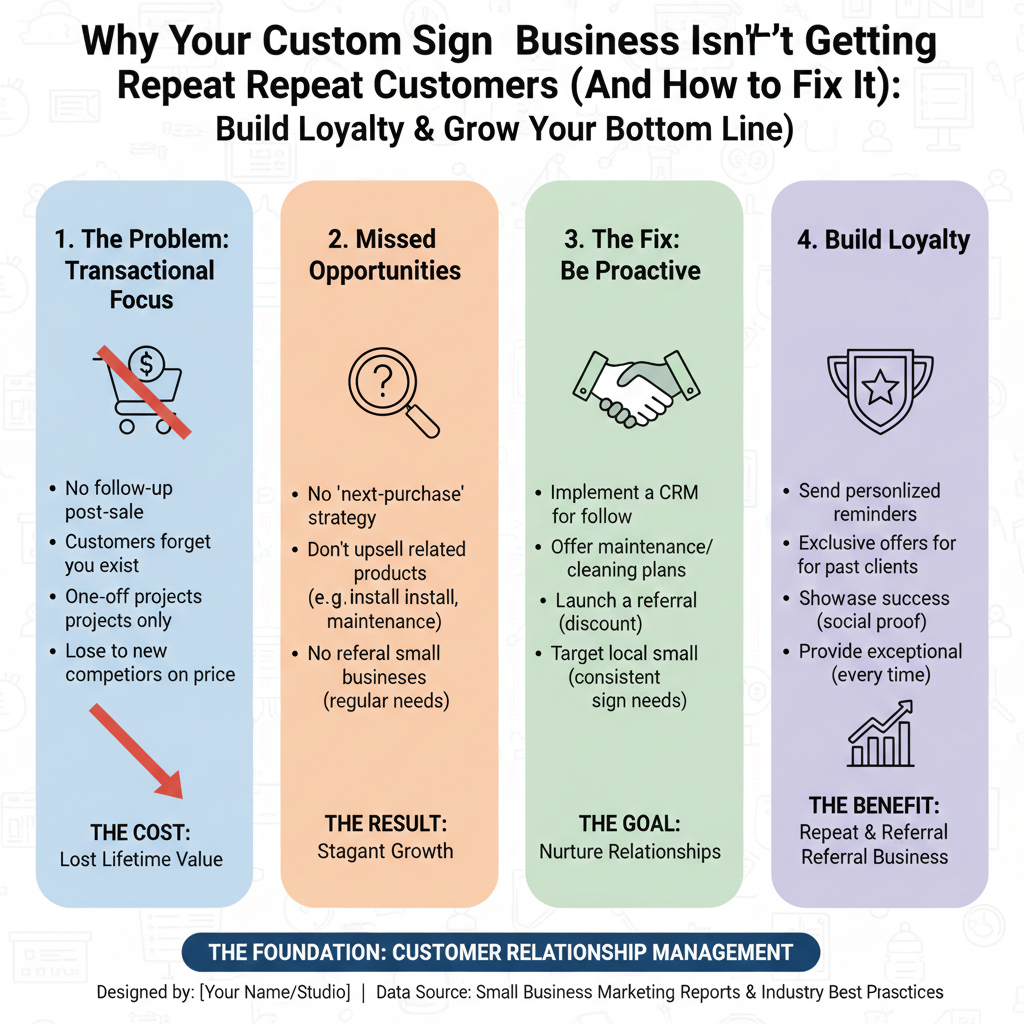
Most sign shop owners accept this as normal. “Signage is a one-time purchase,” they tell themselves. Meanwhile, a small percentage of shops have 40-60% of their revenue coming from repeat customers and referrals. Same products, same market, completely different business models.
After analyzing what separates struggling sign businesses from thriving ones, I’ve identified seven critical issues destroying repeat customer potential — and more importantly, how to fix each one.
Your Business Name Is Costing You Referrals
Here’s a test: Ask three satisfied customers to recommend your business to someone else. Can they remember your exact business name? Can they find you when they search online?
Most can’t. And that’s costing you thousands in lost referrals.
I recently consulted with a sign shop owner who couldn’t understand why referrals never materialized despite excellent customer satisfaction. His business was called “Custom Signs & Printing Services.” Sounds professional, right?
The problem: There are 47+ businesses in his region with nearly identical names. When his happy customers tried to refer friends or colleagues, they’d search variations like “custom sign printing” or “sign services near me.” They’d find his competitors, not him. Some referrals ended up buying from competitors while thinking they were following the original recommendation.
This isn’t just about SEO. It’s about basic recall and discoverability. If customers can’t remember your exact name or easily find you when searching, your word-of-mouth marketing is broken at the source.
The fix requires understanding the competitive landscape. Before investing more in marketing with a forgettable name, audit how many similar businesses exist. You might discover your name is drowning in a sea of nearly identical competitors, making you effectively invisible to potential referrals.
One shop owner I advised changed from “Pro Print & Signs” to “Hexagon Signworks” after discovering 28 competing businesses with “Pro Print” or “Pro Signs” in their names. His referral traffic increased 240% within three months simply because customers could now actually find him when searching.
If you’ve already built brand equity, you don’t need to start over completely. You can evolve your name by adding a unique identifier, emphasizing a memorable element, or creating a distinct abbreviation. The goal is being findable and memorable in a crowded market.
Your Follow-Up Emails Are Never Reaching Customers
Most sign businesses collect customer emails for future marketing. Smart move. But here’s what’s actually happening to those carefully collected addresses:
35-50% of the emails you collect never receive your follow-up messages. Why? Because a significant portion are temporary, disposable addresses that customers use to complete their order, then abandon immediately.
Think about the customer journey: They need a quick yard sign or some custom decals. They fill out your order form, which requires an email. They’re busy, distracted, or privacy-conscious, so they use a throwaway email address just to complete the transaction. They get their order confirmation, receive their products, and that email address dies.
Six months later, you send an email announcing your new product line or holiday promotion to all past customers. Half your messages bounce. Your carefully crafted campaign reaches only 50% of your intended audience. And you wonder why email marketing doesn’t work.
This isn’t malicious behavior. It’s a smart consumer privacy practice in an era of email overload. But it’s devastating for your repeat business strategy.
You’re building an email list that looks impressive on paper (800 past customers!) but delivers terrible results. You send campaigns that cost time and potentially money, get high bounce rates, and see minimal response. The problem isn’t your message or offer — it’s that your audience isn’t receiving it.
The solution involves validating email quality at the point of collection. When someone provides an email address during checkout or quote requests, your system should verify it’s a legitimate, permanent address rather than a temporary one.
This doesn’t mean rejecting customers — it means politely asking them to provide a real email if they want to receive updates, promotions, or important order information. Real customers who actually want to hear from you don’t mind. Casual buyers who were never going to return anyway move on. Either outcome is better than building a ghost email list.
This also protects your sender reputation—email platforms like Gmail and Outlook track bounce rates. If you’re constantly sending to invalid addresses, your domain gets flagged as potential spam. Eventually, even your legitimate emails to real customers start landing in junk folders, creating a downward spiral that’s hard to reverse.
You’re Wasting Time on Fake Quote Requests
Not all quote requests are real opportunities. Some are competitors doing research. Some are students working on projects. Some are people with zero buying intent, just browsing possibilities.
The problem gets worse when these fake inquiries come through temporary email addresses. You spend 20-30 minutes creating a detailed custom quote, send it off, and never hear back. No response to follow-ups. The email address stops working after a week.
This isn’t just frustrating — it’s expensive. If you spend 30 minutes on quotes that are actually serious, that’s valuable. If half your quotes go to fake inquiries, you’re wasting 15 hours per month on leads that were never real.
Better qualification upfront prevents this. Simple phone verification, requiring company information for commercial quotes, or filtering obvious temporary emails, saves massive time. One sign shop owner implemented basic email validation and saw his quote-to-sale conversion rate jump from 12% to 31% — not because he got better at sales, but because he stopped wasting time on fake opportunities.
Your Product Pages Aren’t Being Found
You’re relying on social media, maybe running ads, getting some direct traffic. But here’s a question: When someone Googles “custom yard signs [your city]” or “restaurant compliance signage,” does your business appear?
Probably not.
Most small sign shops focus entirely on social media and referrals, forgetting that Google is still how many commercial buyers research vendors. A restaurant owner needs health code signage, Googles it, and finds three competitors. You never even knew they were searching.
The technical problem is usually your sitemap. Search engines need a clear map of all your service and product pages to index them properly. If Google doesn’t know your “custom real estate signs” page exists, it can’t show that page when people search for exactly what you offer.
This is especially painful for long-tail commercial searches. Someone searching “custom food truck menu board signs [your city]” is a high-intent buyer ready to purchase. If your relevant service page isn’t indexed, they find a competitor instead, and you never knew the opportunity existed.
The fix is straightforward but often overlooked: generate a proper XML sitemap listing all your product and service pages, then submit it to Google Search Console. Many modern website platforms do this automatically, but if you’re running a custom site or an older platform, you need to handle this manually.
Tools exist that crawl your website and generate comprehensive sitemaps automatically. This isn’t glamorous work, but it’s the difference between being invisible to commercial buyers actively searching for your services and capturing high-intent traffic that competitors are missing.
Your Pricing Structure Signals Amateur
Pricing psychology matters enormously in the signage business. How you structure prices tells customers whether you’re a professional operation or a side hustle.
If all your signs are roughly the same price regardless of size, materials, or complexity, you look like someone who doesn’t understand their own business. If your prices are 40% below market across the board, customers suspect quality issues or used materials.
Here’s what professional sign companies do differently:
Transparent Cost Tiers: They clearly separate budget, standard, and premium options. “Yard Sign: Corrugated plastic $25, Aluminum $45, Dibond composite $75.” This helps customers self-select and prevents “why is this more expensive” confusion.
Material Education: They explain why materials cost different amounts. “Our weather-resistant laminate adds $8 but extends outdoor life from 6 months to 3+ years.” Customers appreciate transparency and make informed decisions.
Complexity Pricing: Simple text-only signs cost less than full-color designs with logos. One color costs less than four colors. Standard sizes cost less than custom dimensions. This makes sense to customers and reflects actual production costs.
Volume Discounts: Clear quantity breaks encourage larger orders. “1-10 stickers: $3 each. 11-50: $2.25 each. 51-100: $1.75 each.” Business customers especially appreciate predictable scaling.
Review your pricing structure honestly. If it looks random and inconsistent rather than strategic and tiered, you’re leaving money on the table and signaling unprofessionalism to commercial buyers who compare multiple vendors.
You Have No Systematic Follow-Up Process
After someone buys a yard sign or some custom decals, what happens? If the answer is “nothing until I post on social media about a new product,” you’re leaving massive revenue on the table.
First-time customers are expensive to acquire through advertising and marketing. Repeat customers are pure profit. Yet most sign shops treat every sale as the end of the relationship rather than the beginning.
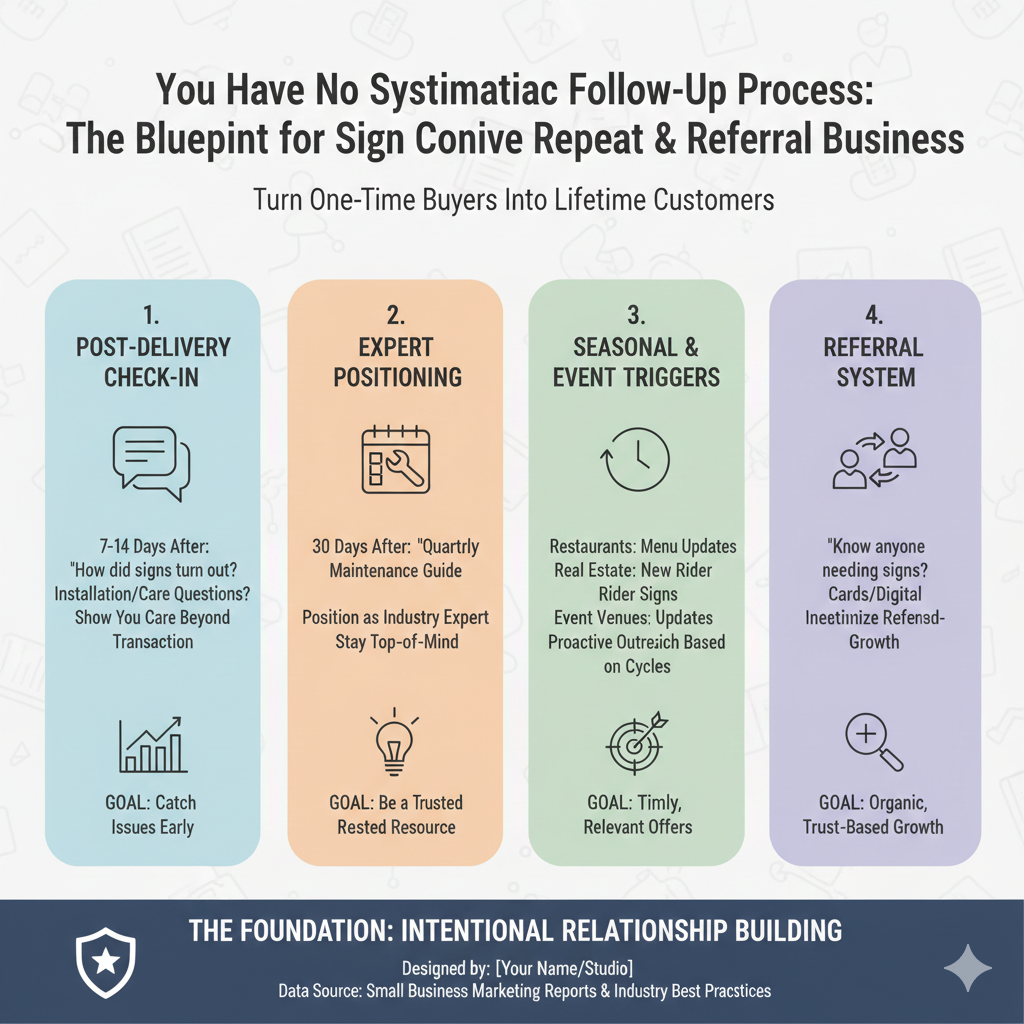
Successful sign companies have systematic follow-up sequences:
7-14 Days Post-Delivery: “How did the signs turn out? Do you have any questions about installation or care?” This catches any issues early and shows you care about results, not just transactions.
30 Days Post-Delivery: “Quick reminder: If you’re using outdoor signage, we recommend checking mounting quarterly. Here’s a quick maintenance guide.” This positions you as an expert and keeps you top-of-mind.
Seasonal Triggers: Restaurants need seasonal menu updates. Real estate agents need new rider signs when they change brokerages. Event venues need updated directional signage. Know your customers’ business cycles and reach out proactively.
Referral Requests: “We’re looking to help more businesses like yours with signage. Do you know anyone who might need similar solutions?” Make it easy to refer with referral cards or digital sharing.
This doesn’t require expensive automation. A simple spreadsheet tracking customer purchase dates and a calendar reminder system works fine when you’re small. As you grow, basic CRM tools handle it.
The key is intentionality. Treat customer relationships as ongoing conversations, not one-time transactions. The companies making $200k-500k+ annually typically have 50-70% of revenue from repeat and referral customers. This didn’t happen accidentally.
You’re Invisible to Commercial Buyers
The commercial signage market (restaurants, retail stores, offices, property management companies) represents 70% of total signage spending. Yet most small shops focus almost exclusively on consumer buyers (individuals needing yard signs, event signage, personal decals).
Why? Because reaching commercial buyers requires different marketing than posting on Facebook.
Commercial buyers search differently. They Google “restaurant health code signs [city]” or “property management building signage.” They ask their business networks for vendor recommendations. They check industry-specific forums and groups.
If your marketing is entirely consumer-focused, you’re invisible to the much larger commercial market.
The fix requires strategic positioning:
Industry-Specific Landing Pages: Create pages targeting specific industries. “Restaurant Signage Solutions” with examples of menu boards, health code compliance signs, bathroom signage, etc. This ranks for industry-specific searches.
Commercial Portfolio: Showcase business clients prominently. Other businesses want to see you’ve served similar companies, not just individuals.
B2B-Focused Content: Write about commercial pain points. “Why Your Restaurant Needs Better Health Code Signage (Before the Inspector Arrives)” attracts restaurant owners actively searching for solutions.
Professional Procurement Process: Offer invoice terms, purchase orders, and bulk pricing. Commercial buyers expect this; consumers don’t need it.
One sign shop owner added three industry-specific landing pages (restaurants, property management, retail stores) and saw commercial inquiries increase from 15% to 52% of total quote requests within four months. Same business, same capabilities, just visible to buyers who were previously finding competitors.
Your Mobile Experience Is Destroying Conversions
Quick test: Pull out your phone right now and try to request a quote or place an order through your website. How many steps? How easy is it? Can you upload design files easily? Is the contact form mobile-friendly?
75% of sign shop website traffic now comes from mobile devices. Yet many sites are optimized for desktop, creating terrible mobile experiences that kill conversions.
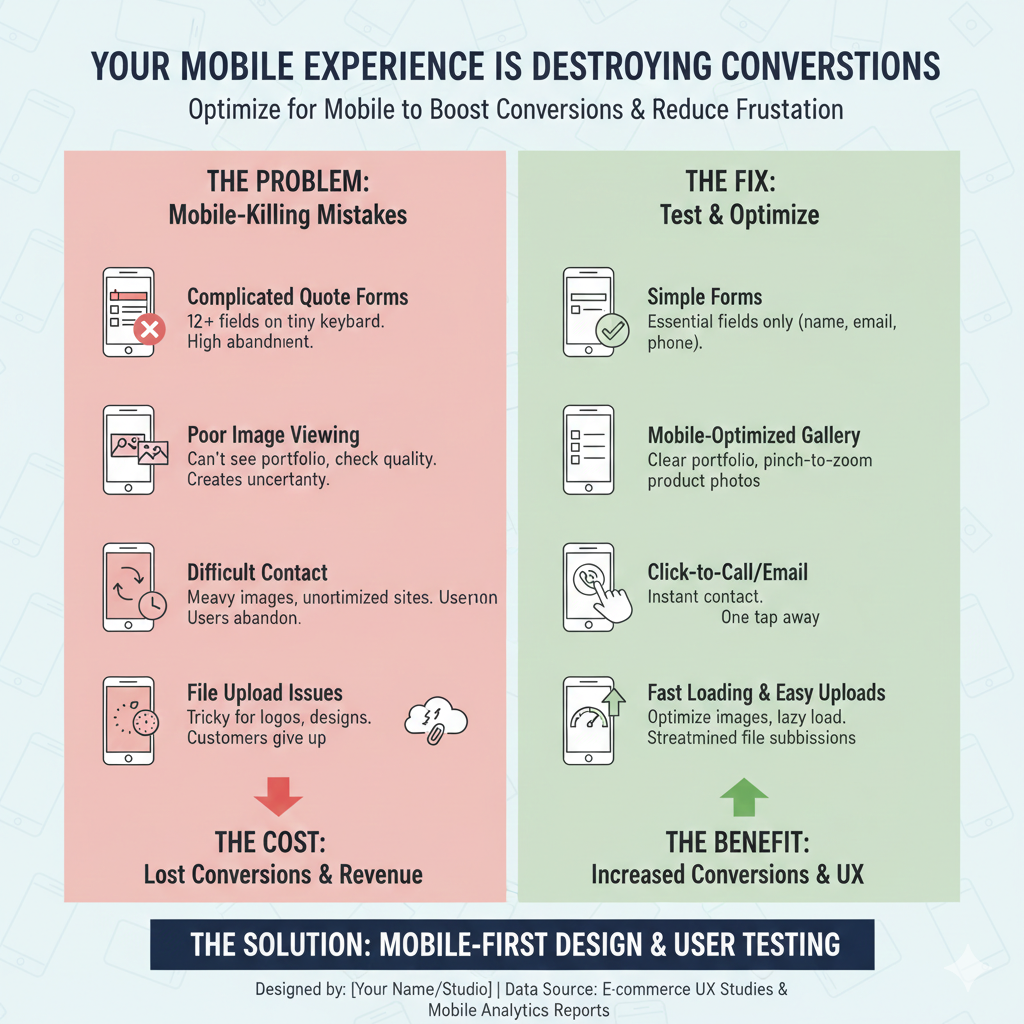
Common mobile-killing mistakes:
Complicated Quote Forms: If requesting a quote requires filling out 12 fields on a tiny keyboard, most people abandon. Simple fields (name, email, phone, brief description) work better than comprehensive forms.
Poor Image Viewing: Customers can’t see portfolio examples clearly. They can’t zoom product photos to check quality. This creates uncertainty that prevents buying.
Difficult Contact: If calling requires manually copying a phone number and switching apps, many won’t bother. Click-to-call buttons are essential.
Slow Loading: Heavy images and unoptimized sites frustrate mobile users. Every second of loading time costs conversions.
File Upload Issues: Mobile file uploading is tricky. If customers can’t easily submit their logo or design from their phone, they’ll give up or choose a competitor with easier process.
The fix: Test your entire customer journey on a mobile device. Better yet, watch a stranger try to request a quote on their phone while you observe. The friction points become painfully obvious.
The Real Problem Might Be Simpler
Sometimes sign businesses struggle not because of sophisticated marketing failures but because of basic service issues.
Ask yourself honestly:
- Do you respond to quote requests within 4 hours during business hours?
- Are your turnaround times realistic and consistently met?
- Do you proactively communicate if there are any delays or issues?
- Is your work quality genuinely excellent, or just “good enough”?
- Do you make the ordering process easy, or does it require multiple back-and-forth emails?
- Are your products packaged properly to arrive undamaged?
A sign shop with mediocre marketing but exceptional service will outperform a shop with brilliant marketing but sloppy execution every single time.
Your 30-Day Fix Plan
Here’s a systematic approach to diagnosing and fixing repeat customer issues:
Week 1 – Audit Phase:
- Check your business name uniqueness and online visibility
- Analyze your customer email list quality and bounce rates
- Review your website’s mobile experience and quote process
- Test your Google Search visibility for key service terms
Week 2 – Technical Fixes:
- Generate and submit proper sitemap to Google
- Implement email validation at quote/order forms
- Optimize mobile quote request process
- Set up basic tracking for referral sources
Week 3 – Strategic Adjustments:
- Create commercial buyer-focused landing pages
- Develop customer follow-up email templates
- Review and standardize pricing structure
- Build industry-specific portfolio examples
Week 4 – Launch and Monitor:
- Implement systematic follow-up sequence
- Track which fixes impact conversion and retention
- Survey past customers about their experience
- Adjust based on feedback and results
The Bottom Line
Your sign business isn’t failing to get repeat customers because of market saturation or price competition. It’s failing because of specific, fixable issues in your systems, customer experience, findability, or follow-up process.
The difference between a shop doing $50,000 annually with constant customer acquisition struggles and a shop doing $300,000 with 60% repeat/referral business often isn’t the quality of signs. It’s these invisible customer retention optimization details that amateurs ignore and professionals obsess over.
Most of your competitors are making the same mistakes you are. Fix these issues and you don’t need to be perfect — you just need to be notably better than the other 75% who never systematically address customer retention.
The question isn’t whether your business can build a repeat customer base. It’s whether you’re willing to identify and fix what’s actually broken rather than just working harder at customer acquisition.
Start with the diagnostic. Find your biggest retention leak. Fix it. Move to the next one. That’s how struggling shops become thriving businesses with predictable, recurring revenue.
