
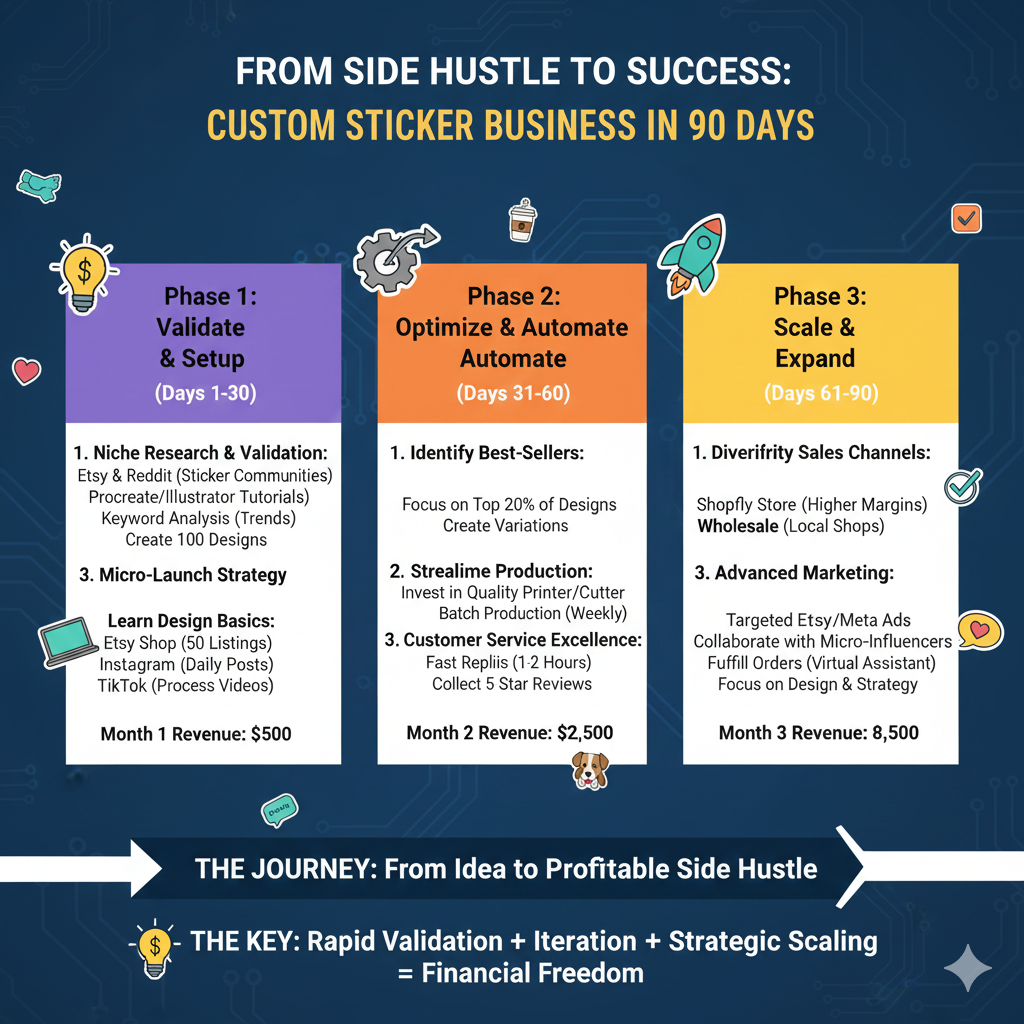
I Built a $8,500/Month Custom Sticker Side Business in 90 Days (While Working Full-Time)

Most people think starting a sticker business requires:
- Expensive equipment ($10,000-30,000)
- Physical storefront
- Huge inventory
- Design expertise
- Full-time commitment
I started with $800, my laptop, and 10-15 hours weekly.
90 days later: $8,500 monthly revenue. 40+ repeat customers. Zero employees.
Here’s the exact process that works.
The Business Model That Actually Scales
Traditional sticker business model: Buy printer → Print stickers → Sell stickers → Compete on price with Amazon.
My model: Become the design and sales expert. Partner with print shops for production. Focus on high-margin custom work, not commodity products.
What this means:
- No equipment investment
- No inventory headaches
- No production bottlenecks
- Focus only on customer acquisition and design
- 60-70% margins instead of 20-30%
Week 1-2: The Foundation Sprint
Day 1-3: Market Research
Instead of trying to compete with Sticker Mule on generic stickers, I researched who needs custom stickers but can’t find good solutions:
Underserved markets I discovered:
- Small product businesses needing packaging labels (1,000-5,000 pieces)
- Event planners needing custom event stickers (weddings, corporate events)
- Local businesses needing branded stickers for marketing
- Real estate agents needing property info stickers
- Food trucks needing menu stickers that change seasonally
- Craft breweries needing beer label stickers
- Etsy sellers needing product packaging materials
The pattern: These customers need custom work, fast turnaround, and willing to pay premium pricing for good service.
Day 4-7: Business Setup
Critical decision: Business name
This is where most people stall for weeks. Picking names, changing minds, overthinking.
My process:
- Generated 20 potential names using AI naming tools – took 15 minutes vs. days of brainstorming
- Checked how many similar businesses existed with each name in my target market
- Verified domain availability for top 5 choices
- Picked one and moved on (total time: 90 minutes)
Why this matters: Generic name like “Custom Stickers” puts you in competition with 5,000+ businesses. Unique, searchable name means when customers find you, they only find YOU.
Other setup tasks:
- Registered business ($150)
- Created simple website on Shopify ($29/month)
- Set up business Instagram and Facebook
- Opened business bank account
Day 8-14: Production Partnership
Found 3 local print shops willing to do fulfillment:
- Quoted me wholesale pricing (I mark up 100-150%)
- 3-5 day turnaround
- Quality samples reviewed in person
- No minimum order quantity
Key negotiation: “I’ll send you 5-10 orders monthly to start. As I grow, you grow. I need consistent quality and reliable delivery.”
Chose the shop with best quality, even if 10% more expensive. Quality = repeat customers.
Month 1: First Sales Without Paid Ads
The local business strategy:
Week 1-2: Research and Outreach
Made a list of 50 local businesses that could use custom stickers:
- 10 coffee shops (branded cup stickers, loyalty program stickers)
- 8 boutique retail stores (packaging stickers, sale stickers)
- 12 food trucks (menu stickers, promotional stickers)
- 10 craft businesses (product labels, thank you stickers)
- 10 service businesses (branded thank you stickers, referral program stickers)
Outreach method:
Not cold email. Not Instagram DMs. Physical visits.
Visited each business with a sample pack:
- 3-4 sticker designs mockups specific to their business
- Pricing sheet
- Business card
- “I’m launching a local custom sticker business and created these concepts for you. Would love your feedback.”
Results:
- 6 businesses placed orders immediately (average order: $250)
- 12 asked to see more designs
- 4 said “not now but keep in touch”
- Rest weren’t interested
First month revenue: $1,500 from 6 local customers
The Pricing Strategy That Wins Premium Work
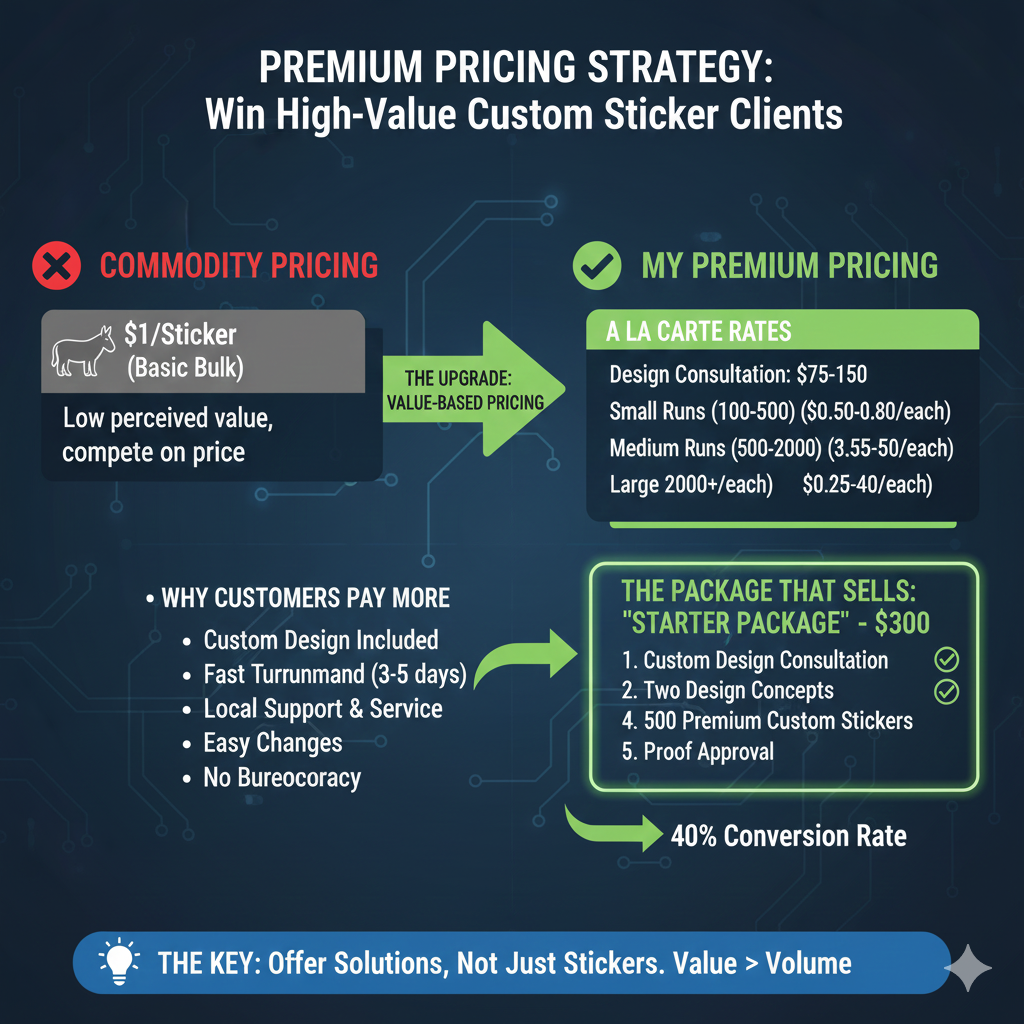
Commodity pricing: Sticker Mule charges $1/sticker for basic custom stickers in bulk.
My pricing for custom design + production:
- Design consultation: $75-150 (often waived if order placed)
- Small runs (100-500 stickers): $0.50-0.80 each
- Medium runs (500-2,000): $0.35-0.50 each
- Large runs (2,000+): $0.25-0.40 each
Why customers pay more:
- Custom design work included
- Fast turnaround (3-5 days vs 7-10 days)
- Local support and service
- Can make changes easily
- No corporate bureaucracy
The package that sells:
“Starter Package” – $300:
- Design consultation
- 2 design concepts
- 1 round of revisions
- 500 custom stickers
- Proof approval before printing
This converted 40% of prospects vs. 15% when I just quoted per-sticker pricing.
Month 2: The E-commerce and Etsy Explosion
Discovery: Etsy sellers desperately need custom packaging stickers but hate dealing with generic print shops.
The approach:
Created Etsy-specific service page on my website:
- “Custom Packaging Stickers for Etsy Sellers”
- Examples of thank you stickers, product labels, shop branding stickers
- Package specifically for Etsy sellers
Etsy Seller Package – $200:
- “Thank You for Your Order” stickers (250 pieces)
- Product label design + 250 labels
- Shop logo stickers (250 pieces)
Promoted in Etsy seller Facebook groups (free) with helpful content, not sales pitches:
- Posted about packaging tips
- Shared examples of good vs. bad sticker packaging
- Answered questions about sticker materials
- Mentioned my service casually in comments
Month 2 results:
- 12 Etsy sellers purchased packages ($2,400)
- 3 became repeat customers with monthly orders
- Average repeat order: $150-300 monthly
Month 2 revenue: $3,900 (local + Etsy)
The Wedding and Event Discovery
Unexpected opportunity: Wedding planner contacted me through website for custom wedding favor stickers.
Realized: Event industry needs tons of custom stickers but most sticker businesses don’t market to them.
Events that need custom stickers:
- Weddings (100-500 guests)
- Corporate events
- Birthday parties (especially milestone birthdays)
- Baby showers
- Graduation parties
- Product launches
- Grand openings
Event sticker needs:
- Favor bag stickers/seals
- Thank you stickers
- Date/name custom stickers
- Branded event stickers
- Directional stickers
- Schedule stickers
Event Package – $450:
- Custom design with event details
- 3 design revisions
- 300 premium die-cut stickers
- Rush production (2-3 days)
- Proof within 24 hours
The marketing approach:
Connected with 15 local event planners on Instagram. Sent each:
- Free sample pack of 50 stickers (cost me $15 each = $225 total)
- “I’d love to be your go-to sticker vendor for events”
- Link to portfolio of event sticker work
4 event planners started sending me business regularly. Average 2-3 events monthly = $900-1,350 monthly recurring revenue.
Month 3: Systems and Scaling
By month 3, handling orders became overwhelming with full-time job.
The systematization:
Order processing workflow:
- Customer inquiry comes in
- Send automated questionnaire (design preferences, quantities, timeline)
- Create mockup in Canva (30-45 minutes)
- Customer approves
- Send to print partner
- Print partner ships directly to customer
Time per order: 1-2 hours (down from 4-5 hours initially)
Automation tools used:
- Calendly for design consultations (no back-forth scheduling)
- Canva templates for common designs
- Google Forms for order intake
- Trello for project tracking
Month 3 breakdown:
- 8 local business orders: $2,000
- 15 Etsy seller orders: $2,250
- 6 event orders: $2,700
- 4 repeat business customers: $1,550
Month 3 revenue: $8,500 Time spent: 50-60 hours (12-15 hours weekly)
The Testing Strategy That Prevents Mistakes
Critical lesson learned the hard way:
First event order, I didn’t properly proof the date. Printed 300 stickers with wrong event date. Cost me $120 to reprint + lost trust with event planner.
New testing protocol:
Before sending any design to print:
- Have customer approve digital proof via email
- Print 1 test sticker myself (even if just inkjet on sticker paper)
- Take photo next to ruler showing actual size
- Send photo to customer for size confirmation
- Get written “approved for printing” confirmation
Where ecosystem tools helped:
When testing new marketing channels or signing up for vendor platforms, I used temporary email addresses to test which platforms actually generated quality leads vs. time-wasters.
Tried 8 different online marketplaces and seller platforms. Only 3 generated real inquiries. The temp emails let me test all without cluttering my business inbox with spam from low-quality platforms.
The Website That Actually Converts
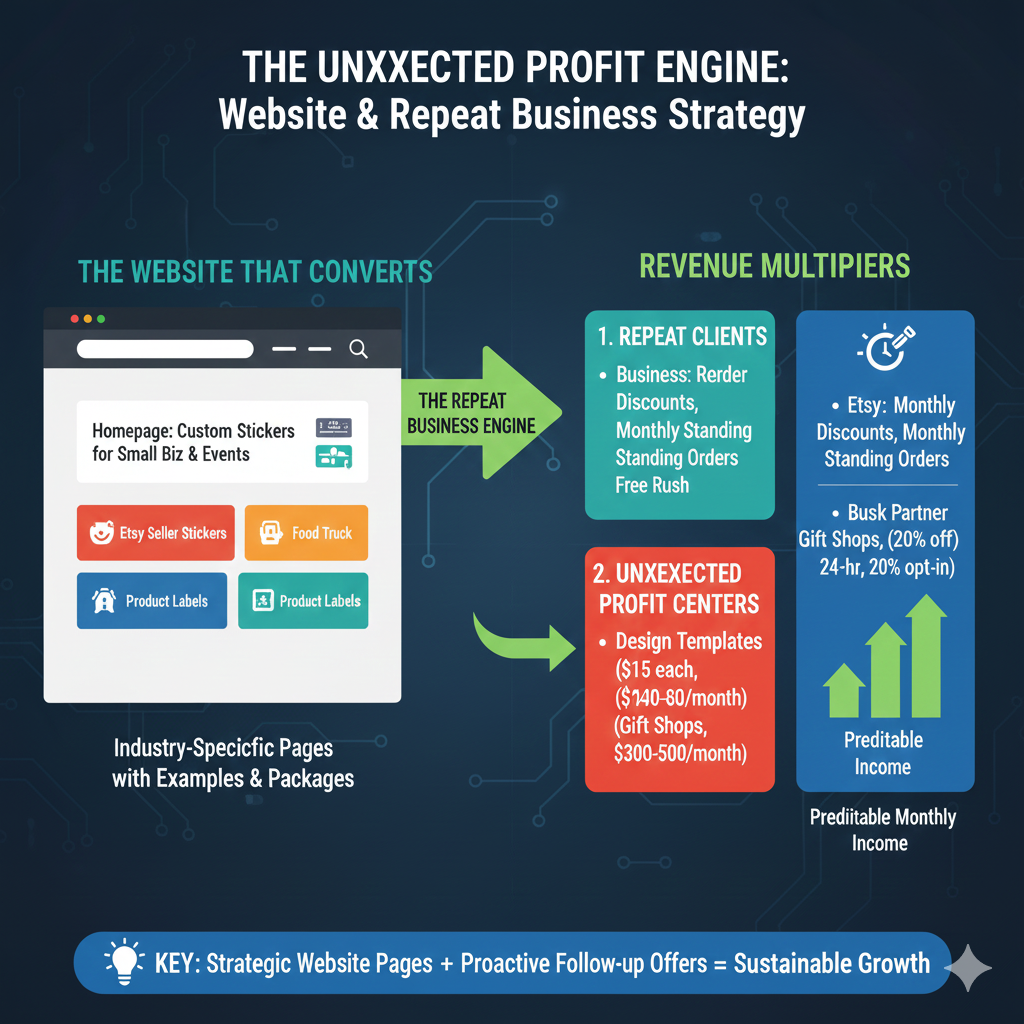
Most sticker business websites: Generic homepage. “Contact us for quote.” No pricing. Unclear what makes them different.
My website structure:
Homepage: Clear value proposition – “Custom Stickers for Small Businesses & Events – Design Included”
Industry-specific pages:
- /etsy-seller-stickers
- /wedding-stickers
- /business-branding-stickers
- /food-truck-menu-stickers
- /product-label-stickers
Each page shows real examples, pricing packages, typical use cases.
The Repeat Business Engine
One-time customers = constant hustle for new sales. Repeat customers = predictable revenue.
How I turned 40% of customers into repeat buyers:
For business customers:
- “Reorder in 30 days and get 15% off”
- Followed up 25 days after first order: “Running low on stickers?”
- Offered “standing monthly order” option (same design, automatic monthly shipment)
For Etsy sellers:
- Created “Monthly Packaging Bundle” – Same thank you stickers delivered monthly for $140
- 8 sellers signed up = $1,120 recurring monthly revenue
For event planners:
- “Partner Pricing” – 20% off for planners who send 3+ events
- Free rush production for repeat clients
- Kept sample packs stocked so planners could show clients
The Unexpected Profit Centers
Revenue sources I didn’t plan for:
1. Sticker sheet design templates: Etsy sellers kept asking for same design styles. Created 10 templates they could customize. Sold templates for $15 each. Made $600 selling templates with zero production cost.
2. Bulk wholesale: Local gift shop wanted to sell my sticker designs. Negotiated wholesale pricing. They order 500-1,000 stickers monthly. Passive $300-500 monthly.
3. Rush fees: Offered 24-hour turnaround for $100 rush fee. 20% of customers paid it. Added $400-600 monthly revenue.
The Real Numbers
Investment: $800
- Business registration: $150
- Website: $30
- Initial samples and materials: $300
- Business cards and marketing materials: $200
- First month Shopify: $30
- Misc expenses: $90
Month 1 revenue: $1,500 Month 2 revenue: $3,900 Month 3 revenue: $8,500
Total 90-day revenue: $13,900 Profit margin: 60-65% = $8,340-9,035 profit
Time investment: 150-180 hours over 90 days (12-15 hours weekly)
Hourly rate: $46-60/hour
Conclusion: The New Blueprint for Product Businesses
The success of this 90-day sprint proves that in 2026, the most valuable part of a product business isn’t the machinery—it’s the market intelligence and design strategy. By positioning yourself as a specialized partner rather than a commodity printer, you transform a simple sticker into a critical business tool for your clients.
You didn’t build a “sticker shop”; you built a brand-elevation service that happens to use stickers as the medium.
Key Takeaways for Your Launch:
-
Own the Relationship, Outsource the Asset: Don’t let a $20,000 printer be the gatekeeper to your dreams. Focus on the high-value tasks: client acquisition, custom design, and project management.
-
The Power of Frictionless Pricing: Moving from “per-unit” quotes to “Solution Packages” (like the Etsy or Wedding bundles) removes the mental math for the customer and speeds up the “Yes.”
-
Systems Over Sweat: Use tools like Canva templates and order questionnaires early. Scaling a side hustle while working full-time is only possible if you spend your limited hours on growth, not administrative back-and-forth.
-
Niche Down to Level Up: Generalists fight for pennies on marketplaces; specialists (like the “Food Truck Menu Expert”) set their own prices.
